


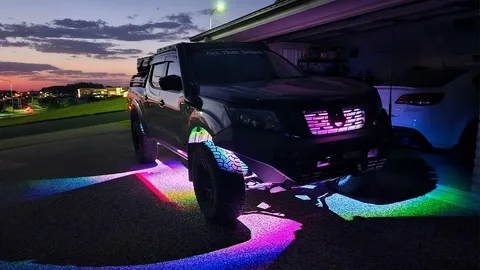
For the Australian off-roader, the adventure doesn’t end when the sun dips below the horizon. Whether you are navigating the tight, timber-lined tracks of the Victorian High Country or tackling a technical rock crawl in the Red Centre, visibility is your greatest asset.
While high-output driving lights and LED lightbars are standard for seeing what’s a kilometre down the road, they often leave a literal “blind spot” right under your wheels.
This is where rock lights come into play. Once considered a purely aesthetic “underglow” accessory, these rugged LED units have evolved into an essential safety and performance tool for serious 4WD enthusiasts.
What Exactly are Rock Lights?
Rock lights are small, high-intensity LED pods mounted within the wheel arches or along the chassis of a vehicle.
Unlike headlights that throw a beam forward, rock lights provide a 360-degree flood of light around the perimeter of the tyres and the underbody.
Their primary purpose is “ground lighting.” When you are crawling over uneven terrain at night, a spotter or the driver needs to see exactly where the rubber meets the rock.
By illuminating the “kill zone”—the area immediately surrounding the vehicle—you can avoid tyre sidewall damage, high-centering on hidden stumps, or slipping into deep ruts that your main beams simply overshoot.
The Practical Benefits: More Than Just Style
1. Precision Tyre Placement
In technical off-roading, an inch can be the difference between a clean line and a snapped CV joint. Rock lights eliminate the shadows cast by your own vehicle, allowing you to see the exact contour of the obstacles beneath you. This is particularly vital for solo drivers who don’t have the luxury of a passenger hopping out to spot for them.
2. Enhanced Safety and Recovery
If you find yourself stuck or needing to perform a recovery after dark, trying to winch or change a tyre with a torch held in your mouth is frustrating and dangerous. A well-placed set of LEDs provides hands-free illumination of your suspension components, recovery points, and tyre valves, making maintenance in the bush significantly safer.
3. Campsite Utility
Beyond the trail, these lights serve as excellent “puddle lights.” They illuminate the ground as you exit the vehicle, helping you avoid stepping on snakes, spiders, or into deep mud. They also provide a soft ambient glow around the vehicle, making it easier to set up camp or find gear in the tray without the blinding glare of a high-powered camping light.
Why Lighting Matters: The Australian Context
In Australia, road and trail safety is a paramount concern, especially given our vast distances and nocturnal wildlife. According to data from the Australian Bureau of Statistics (ABS) and various state transport authorities, heavy vehicle and regional road incidents often peak during low-light hours. While rock lights are designed for off-road use, the emphasis on “seeing and being seen” is a core tenet of Australian vehicle safety standards. Proper illumination reduces driver fatigue by minimising the strain of trying to peer into the darkness.
Furthermore, the Department of Infrastructure, Transport, Regional Development, Communications and the Arts sets strict Australian Design Rules (ADRs) for vehicle lighting. While rock lights are generally classified as work lights or off-road auxiliary lights, it is vital to ensure they are wired to a dedicated switch so they are not used on public bitumen roads, where they could dazzle other drivers.
Choosing the Right Setup
When selecting a kit, look for a high IP (Ingress Protection) rating. Australian conditions are unforgiving; your lights will be submerged in river crossings, pelted with salt spray on Fraser Island, and baked in 40-degree Outback heat. An IP68 or IP69K rating ensures the units are dust-tight and waterproof.
For a visual guide on how these lights perform in real-world Australian conditions, check out this comprehensive 4WD lighting guide: 4WD 24-7: Night Driving & Lighting Tips.
Conclusion
Upgrading your rig with a set of rock lights is one of the most cost-effective ways to increase your vehicle’s capability. By prioritising visibility under the chassis, you aren’t just making your 4WD look better—you are protecting your investment from avoidable trail damage and ensuring that your night-time adventures are as safe as possible.
In the rugged Australian wilderness, being able to see what’s beneath you is just as important as seeing what’s in front of you. So, before your next trip to the Cape or the Kimberley, make sure you’ve prioritised the light that matters most when things get technical.
